How to write product copy for AI features without overpromising
Clear AI product copy names the job, the context and the user's control instead of making impossible promises.

By Danish Khan
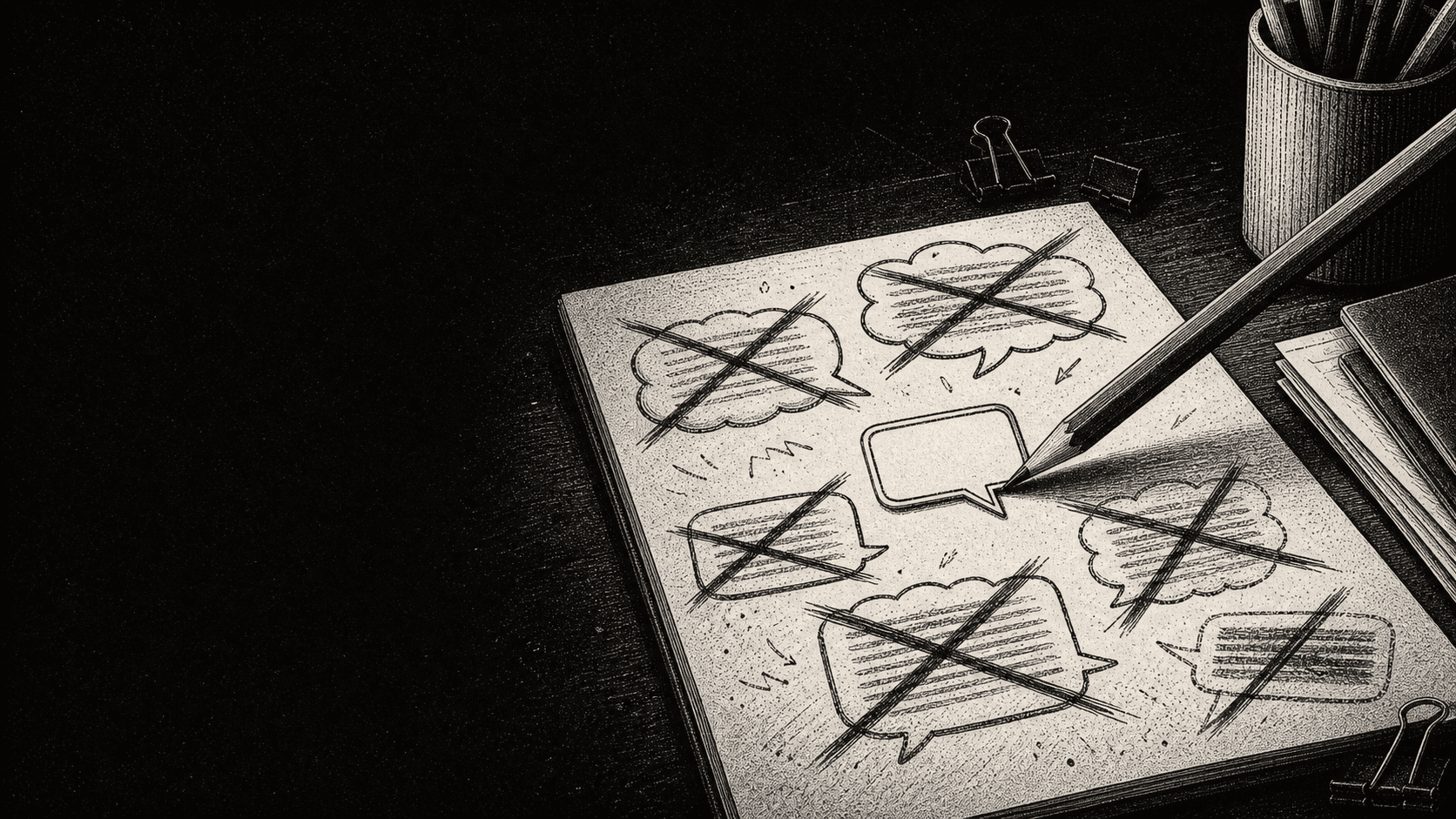
The copy has to carry the real promise
AI makes it tempting to write bigger claims than the product can keep: \u201cworks for you,\u201d \u201cknows everything,\u201d or \u201cnever misses a detail.\u201d They sound impressive until a user asks what the feature will actually do with the information in front of it.
Good product copy makes the capability easier to evaluate. It names the job, the context, and the control the person keeps. That is more persuasive than vague confidence because it gives someone a reason to try the feature.
Start with the outcome, not the technology
\u201cPowered by AI\u201d does not explain a user benefit. Begin with the task that becomes easier.
Instead of: \u201cAn intelligent workspace assistant.\u201d
Try: \u201cTurn a meeting into a follow-up draft and proposed tasks.\u201d
The second line helps a person picture the moment they would use it. It also gives the product team a test: if the feature cannot reliably deliver that outcome, the copy needs to become more precise.
Say what the feature uses
AI output depends on its inputs. Copy should tell people what the feature can draw from, especially in a workspace product.
For example:
- \u201cCreate a brief from the selected meeting and account notes.\u201d
- \u201cSuggest CRM updates from this call transcript.\u201d
- \u201cDraft a reply using the conversation you choose.\u201d
That small amount of context reduces uncertainty. It is also an honest signal about the boundaries of the feature. The Nielsen Norman Group\u2019s guidance on microcontent is relevant here: concise labels and headings need to communicate the essential meaning without relying on the surrounding page to rescue them.
Describe the user\u2019s control
The most reassuring product copy often includes what happens next. Does the feature draft, suggest, or act? Can someone edit it? Is approval required?
Use verbs that match the actual interaction:
- Draft when the result is editable text.
- Suggest when the product is proposing a choice.
- Prepare when the next action still needs review.
- Send, update, or create only when the feature truly completes that action.
The difference is not pedantic. A button labelled \u201cSend reply\u201d carries a different commitment from \u201cDraft reply.\u201d The wording should make that commitment visible before a person clicks.
Avoid invented certainty
Words such as \u201cperfect,\u201d \u201calways,\u201d \u201cautomatic,\u201d and \u201cunderstands\u201d can create expectations a real product cannot safely meet. Replace them with language grounded in the work:
- \u201cHighlight the decisions and open questions from this meeting.\u201d
- \u201cPropose a follow-up plan based on the notes you selected.\u201d
- \u201cHelp you review recent account activity before a call.\u201d
Specificity is not a weaker form of marketing. It is a stronger form of product positioning because it connects the feature to an observable result.
Let the interface continue the sentence
The promise in a headline should match the label on the button, the empty state, the loading message, and the result screen. If the page says \u201corganise your work\u201d but the first action is \u201cgenerate summary,\u201d the user has to translate the product\u2019s language for themselves.
The best AI product copy behaves like a clear handoff. It tells a person what will happen, what information is involved, and where they remain in control. That is how a feature earns confidence without asking for blind trust.