Why product velocity still needs judgment
Moving quickly matters. Knowing what to ship, what to protect and what to learn matters more.

By Danish Khan
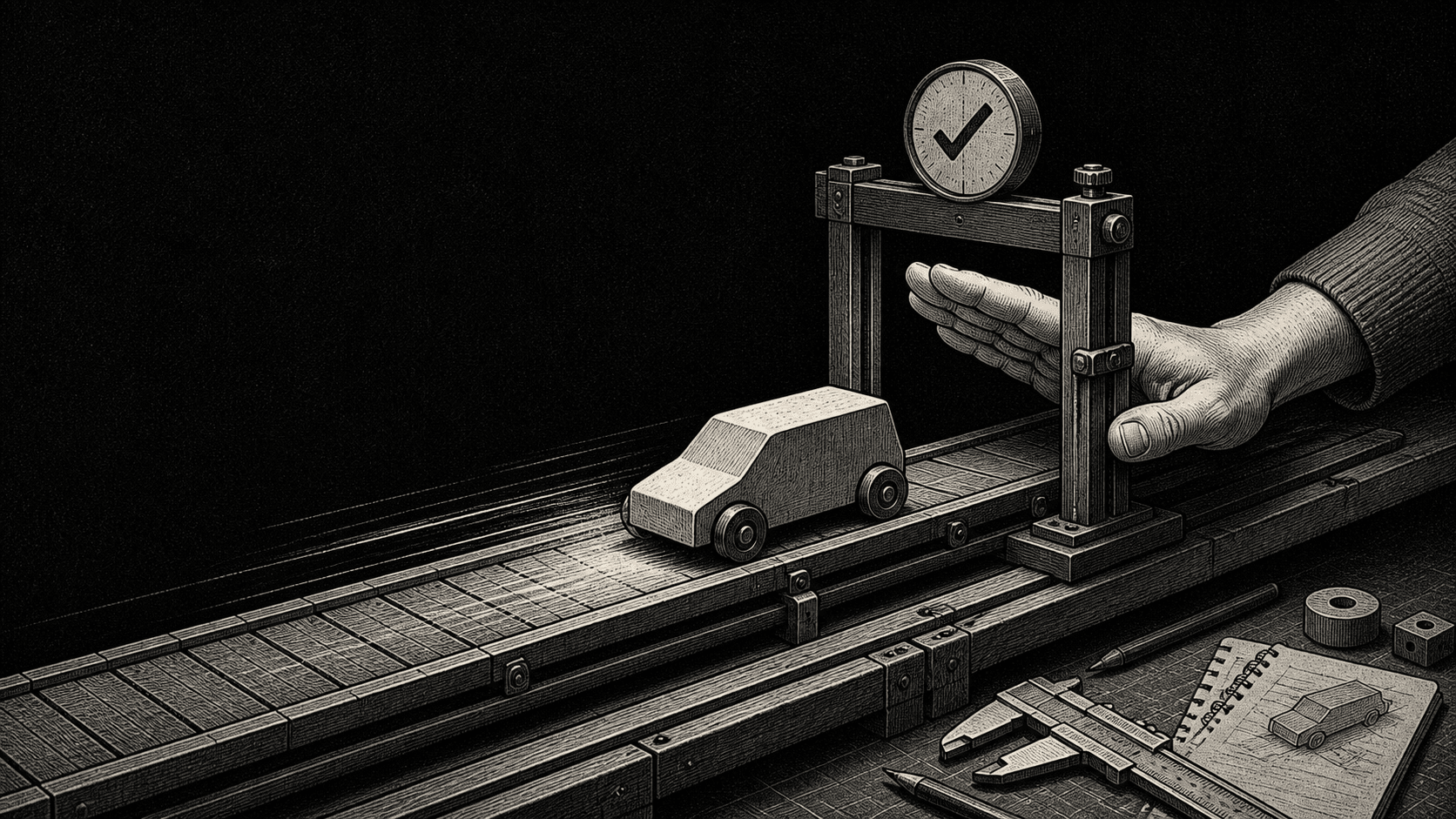
Speed is only useful in the right direction
Teams often describe velocity as the rate at which features ship. That is easy to count, but it is not the whole job.
Real product velocity is the rate at which a team reduces important uncertainty and improves a customer outcome. Some weeks that means shipping a small change. Other weeks it means talking to five users, removing a confusing step, or deciding not to build the feature that looked most exciting in a planning meeting.
Moving fast without judgment can create more work than it removes.
Give every release a question to answer
A useful release begins with a question that is small enough to learn from:
- Will a clearer first screen help people reach the first useful moment?
- Does this workflow remove a repeated manual step?
- Which part of the setup is stopping new users from continuing?
- Will people trust a proposed AI action if they can review it before it runs?
The question gives the team a reason to ship and a way to interpret what happens next. Without it, a release becomes a collection of changes that are difficult to evaluate.
The UK Government\u2019s agile delivery guidance is useful here: work in small increments, learn from users, and adapt based on evidence. The important part is not the ceremony. It is the discipline of treating each increment as an opportunity to learn.
Keep the surface area small
Small releases are easier to understand, test and reverse. They also make it more likely that feedback points to a real cause.
When a team changes onboarding, navigation, pricing language and core workflow behaviour at the same time, any result becomes ambiguous. Did activation improve because the product became clearer, because a different audience arrived, or because a hidden bug stopped people earlier than before?
A smaller change has a cleaner feedback loop. It may feel less dramatic, but it gives the team more usable information.
Protect the parts that need trust
Not every piece of a product deserves the same pace. A headline can be tested quickly. A customer-facing automation, a billing flow, or a permission change should have more deliberate review.
The product decision is not \u201cfast or careful.\u201d It is where care changes the outcome.
For high-impact areas, define the guardrails before the release:
- what must not break;
- who reviews the change;
- how to observe its effect;
- how to roll it back;
- what a user can undo themselves.
Those guardrails are not bureaucracy. They are what allow a team to move decisively when something goes wrong.
Learn from the work that did not ship
Velocity also includes good decisions to stop. A product team that quickly discovers a problem is not urgent, a segment is not a fit, or a feature cannot meet the expected standard has made progress by avoiding a larger investment.
Keep a lightweight record of these decisions: the question, the evidence, the choice and what would change the choice later. It makes the team\u2019s judgment visible and prevents the same half-formed idea from returning every few months as if it were new.
The useful definition
Product velocity is not a sprint scoreboard. It is a habit of choosing the next uncertainty worth resolving, running the smallest responsible move, and letting the result change what happens next.
That kind of speed compounds. The team ships with more intent, customers see fewer careless changes, and every release leaves the product a little easier to understand.